
The path at the end of the mind: Quotes and Reviews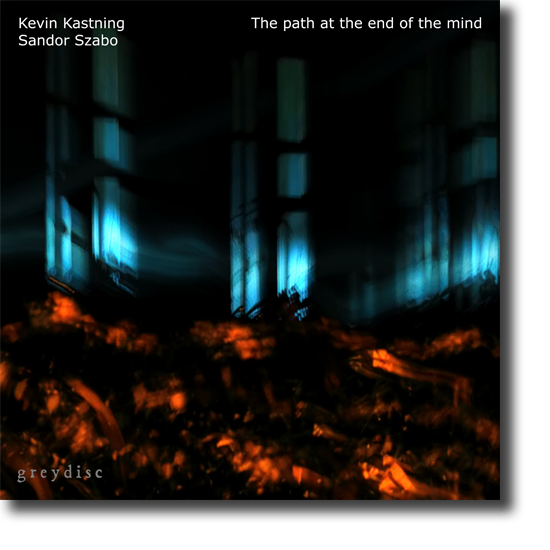
carolbanksweber The
Path at the End of the Mind: An Entire Album of Strung-Up Purgatory
Kevin Kastning, Sandor Szabo unravel what it means to hone in and hunker down on
a modifying target of motif, mood, and migration in progress and collaboration
Carol Banks Weber (Coggie)
Sep 28, 2026
Kevin Kastning and Sándor Szabó aren’t tinkering; they’re threading
self-delight. Their upcoming, six-track Oct. 6, 2026 album, The path at the end
of the mind (Greydisc Records), captures varying degrees of guitar meeting up in
bubbly acoustic discovery. Cover art: George Korunov
It’s hard to pin down what guitarists/composers Kevin Kastning and Sándor Szabó
are doing on their upcoming Oct. 6, 2026 album, The path at the end of the mind,
via Greydisc Records. Perhaps the key lies in the six-instrumental album title,
“The path” and “the mind,” from their 18th recording, and one involving
unconventional multi-string guitars.
The duo tip-toe-taps into the creative unconscious where the head touches the
heart in fervent, spontaneous-feeling interplay, and the rest of the body —
hands and fingers and unlocked rhythms — relaxes and obeys.
American musician Kastning plays multi-string contraguitar, his literal
invention: 30-string contra-baritone, 30-string double contra, and 12-string
baritone, while Szabó, from Törökszentmiklós, Hungary, chimes in on his
16-string classical guitar, giving the pieces a Romantic-Spanish-period
flourish.
What does it all mean for the average listener?
A kind of inner-circle Morse code, intoned out in strips and round-ish beltways
signifying the beginning of one musical train of thought bending and folding
into another, similar to watching lacey linen curtains wave its soft corners
into an open window, following the sound of seagulls floating aimlessly over
lapping pools by a Brittany coast.
Nature opening and closing, seemingly disparate, yet inextricably
interconnected. Truly New Age, wizened and absorbent, taking in facets of jazz,
avant-garde, ambient grey, acoustic classical, and yang succumbing to the
curvaceous guitar lure of the yin attractor.
“Unanswered paths” lets the clothes hang and dry, dragging at first in the
cluster of guitar grapes Kastning picks and peels and weathers, as Szabó
squeezes them into floral wine, as opening rose petals on the first day of
spring. The sound is that of an acoustic form waiting to be revealed, still
entombed in its matte finish, the layers in a state of building, testing,
yielding — guitars hollowing out into their bass brethren, the solo and the
support. Unanswered paths, unfinished ones.
“By the illustrious seeming” lights up certain places in the thread, wanting to
be a little more melodic, but in bursts of ideas, as a child might topple blocks
to restart new sandcastles, ever more curious, ambitious, dreamily elaborating
and extending those thought portions into streams of the real. The idea behind
the muse, before the song completes. Kastning prompting with, What about this?,
Szabó running away with the rest of the décor.
“An apparition of subtleties” enters the roundabout phase, where favorite riffs
and depths begin to deepen and placate, each composer composing soundly entire
chorus-to-bridges in gently falling rain patter, Szabó wanting to dance with the
pithy phrases, Kastning according difference, skewing notes of integrity,
grounded human emotion, easing off the pretty range. A bit of modern art twang
to the flurry of Romantic Baroque Renaissance uncoiling.
“Incalculable pluralities” gets more interesting, complicated, thought bubbles
matriculating into concretized elaboration, a kind of grand, sweeping mist in
cinematic quality, like the opening of a French film where the hero dares
traverse into the dark cave, despite his better judgment, and hears what the
strange slime dripping down unseen walls must smell like to be them. There is
more assertion, the twist of pleasantries, a downward motion dwelling and
catapulting concordant intensities. More to the mix, in bass to guitar to cello-esque
parts — a modestly swinging cowboy number.
Harpsichord’s many splendored things evoke out of “Clarity and yielding,” strum
by strum, as if combined in a string section of at least five to 10 musicians,
instead of one man eliciting the masses. The tangy echo fills the arched
acoustic space of the recording studio with easygoing company, when one of the
lower guitars booms out, appropriately bass-like, with funk residuals cut off
and re-embanked to the What about this? And this? thematic schism. Playing
maybes, with harsh emphasis for effect, before backing away. Something as close
to a furious bass solo — gutted of the rhythm section — cuts in at thy 3/4th
mark. A long motherfucker, despite it’s average 6:29 playing time, because of
the diversity of inflections and strangely surface stirring.
“Of thought evoked” appears to head in another direction, a spinning module of
hesitancy at a turning point confronting too many choices, unrequited emotive
blinking waiting for fruition. Of course, never quite making it there. As
real-time as it gets, picking up the nuances of the soundtracks of our lives,
without committing to any final product.
Snippets of what you’d swear was a brief Shania Twain reference point,
overlapping with coagulated vision, then an un-knotted opening theme of every
1970s sitcom you’d ever sat through. The vibe of a piece of music or a moment in
a jam session of symphonic soloists.
Halfway in, Kastning and Szabó meld their styles together toward the same mental
path, as close to the underpinnings of an actual tune as is possible in this
spacious realm, before separating once more to contemplate the next series of
ticks and triumphs, lifting the last notes into suggestions in an accidentally
metered advancement, by guitarists’ accord. At 8:43, the last instrumental tune
is the longest, filled with squalls and turns and Szabó’s classical unearthing.
Kevin Kastning and Sándor Szabó’s new album together may not be for everyone.
Okay, it’s not.
Listeners who require Top 40 melodic mass appeal and jazz with lyrical
explanation will miss the point (because there isn’t any).
The path at the end of the mind is what happens to two experimental,
inventive musicians who sit in speed to consider possibilities, while simply
enjoying what musical embryos sound like pushing and jostling and inspiring each
other. It’s their path, a basking in, the debris of the day’s joys and worries
and ambient fissures, without a recourse or a set destination — inspiration in
flux in itself.
Most of what they’re doing on these multi-strings is tapping into what could be
and listening as they play to what it inspires next — templates rather than
demos — to get you into their color-coded vibe.
Layers before the stitching, different mosaic muses before the music. Intricate
wafts of whatever time and motivation provide.
Dig?
-
carolbanksweber
October 2026


© 2026 Greydisc Records / Suigeneria Music [BMI]