"Guitarist Kevin Kastning seems to never give
himself a respite. Here he is already back after the recent 2+2,
published in May, on which he collaborated with guitarist Mark Wingfield. Prior
to that, he partnered with drummer Paul Wertico on Interchange One,
released in March. A steady pace of production that perfectly illustrates the
inexhaustible creativity of the American musician.
It is with the trumpeter, conductor and professor at the Berklee College of
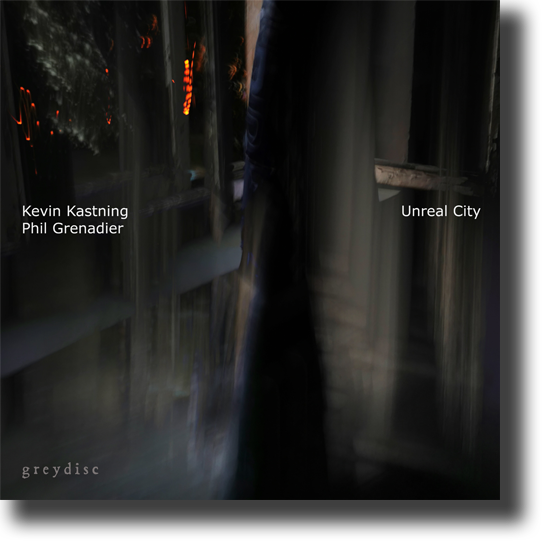
Music, Phil Grenadier that he collaborates this time on Unreal City, second
album bringing together the two men after In Visible Ascent, released in
2024.
In four tracks, the duo takes us into a slow and measured musical dream, where
the trumpet, whose phrasing is reminiscent of that of Miles Davis, often takes
the ascendancy on Kevin Kastning's guitars.
The latter, including the famous 36-string Double Contraguitar designed by Kevin
Kastning himself, shape hallucinated and hypnotic atmospheres, their sounds
evoking in turn a harp or a harpsichord. A wealth of stamps that frequently
gives the impression of hearing a much more extensive set than this duo yet
reduced to its simplest expression.
The whole, halfway between improvisation and carefully thought out composition,
works wonderfully. The musicians listen to each other, respond and complement
each other with a remarkable fluidity, going from a delicate sequence to a
sudden flood of notes without ever breaking the balance of their dialogue. This
ability to alternate restraint and intensity with such ease gives the album an
unusual force of fascination.
With Unreal City, Kevin Kastning and Phil Grenadier achieve a first-class
collaboration, as immersive as it is inspired. It remains only to be hoped that
the two musicians will renew the experience in the future."
Titles:
1. Those are pearls that were his eyes
2. Still point of the turning
3. Never; only revealing
4. Memory passage echo
"Hi, Kevin. Yesterday I was listening to the
album "Unreal City" while working with images. After 10 minutes, I realized I'd
briefly entered another reality. I thought, "How wonderful that your music and
my images are making the shaky foundation of the unreal city a little more
stable." Although perhaps only wandering through a precarious space can yield
something new. Your music, like philosophy, encourages us to pose further
questions in understanding the abstract."
- George Korunov; artist (RUSSIA)
July 2026
Kevin Kastning:
Unreal City
By Sue Yang
July 10, 2026
Kevin Kastning & Phil Grenadier: Unreal City
Unreal City opens as though the room itself has begun to listen. Before
theme, pulse, or recognizable structure settles into place, Kevin Kastning and
Phil Grenadier direct attention toward the grain of musical events: the weight
of a string attack, the bloom of a brass tone, the residue left by resonance,
and the silence that follows, quietly changing the next sound. The album's
intensity comes less from volume or density than from the precision with which
two musicians make each gesture matter.
Kastning's expanded contraguitar family gives the recording its unusual acoustic
terrain. The credited 36-string, 30-string, 24-string and 18-string instruments
extend the guitar beyond familiar behavior, opening a register and color range
that can suggest bass resonance, harp-like shimmer, brittle metallic overtones,
prepared strings and dark chamber resonance. Rather than technical curiosities,
these sounds function as materials of placement and proportion. A note may carry
the force of a structural beam; a harmonic may feel like light catching on a
broken surface; a low resonance may alter the perceived size of the space around
Grenadier's horn.
Grenadier, on trumpet and flugelhorn, brings the album its most directly vocal
element, though his playing rarely settles into conventional lyricism. His
phrases often begin as breath, gather contour, then withdraw before becoming
fully declarative. That restraint is crucial. He moves within Kastning's sound
world rather than standing outside it as a soloist commenting from above. At
different moments he appears as line, flare of brass color, or nearly spoken
inflection. The relationship between the two players is less a dialogue of
alternating statements than a continuous adjustment of weight, distance, and
timbre.
The literary charge of the titles deepens the album without turning it into a
program to be decoded. Unreal City recalls the fractured urban vision of T. S.
Eliot's The Waste Land; "Those are pearls that were his eyes" has its earlier
life in Shakespeare's The Tempest and its later modernist afterlife in Eliot;
"Still point of the turning" points toward the paradox of motion around a still
center associated with Eliot's Four Quartets. These echoes matter because they
place instability, transformation, suspended time and altered memory around the
music, while leaving the performances to determine their own form.
The album's "city" is acoustic rather than descriptive: a field of partial
forms, shadowed corridors, sudden openings and receding surfaces. The four
pieces do not move like chapters in a narrative. They resemble different zones
within the same unsettled environment, each defined by its own duration, density
and internal temperature. Kastning and Grenadier avoid scene-painting. Instead,
they build a world through recurrence, interruption, decay and return.
"Those are pearls that were his eyes" turns the idea of transformation into an
acoustic state. Kastning's lower strings darken the ground rather than securing
it, while Grenadier enters with brief, searching figures that seem to measure
the available air before occupying it. The piece has the force of an opening,
but not because it announces a theme. It changes the listener's attentional
scale. Melody, resonance and silence are placed on equal footing, and the music
asks to be heard as much through what disappears as through what sounds.
"Still point of the turning" sharpens the album's treatment of time. The
performance is active without becoming directional. Kastning's attacks disturb
the surface, yet they do not organize themselves into pulse. The lower registers
create a kind of undertow, while upper partials appear and vanish with a dry,
unstable brightness. Grenadier's lines hover between song and signal. They have
lyrical possibility, but the phrasing remains suspended, held back from release.
What matters here is consequence: a string resonance changes the color of the
next horn tone; a brass phrase leaves an interval of space that alters
Kastning's next move.
"Never explaining; only revealing" gives the album its clearest aesthetic
statement. At just over ten minutes, the piece turns duration into method. It
does not develop through argument, exposition or dramatic escalation. Instead,
Kastning and Grenadier allow small differences to accumulate until the music's
form becomes perceptible from within. Kastning generates low-register mass,
sharp upper partials and sudden fractures of articulation. Grenadier often lets
pitch emerge gradually from breath, so that tone feels discovered rather than
announced. The result is rigorous without becoming rigid. Nothing is overstated,
yet very little feels incidental.
"Memory passage echo," the final and longest track, expands the album's logic
into its broadest shape. It does not function as a closing statement in the
usual sense. It behaves more like an acoustic memory system. Elements from
earlier in the album seem to return, but altered by distance: low string weight,
suspended horn tones, metallic afterimages, pauses that feel charged rather than
empty. The title's sequence is revealing in itself. Memory moves through
passage; passage returns as echo; echo changes the outline of what seemed
original. Kastning and Grenadier make this process audible without forcing it
into a thesis. The piece gradually recedes, leaving a changed sense of space
rather than a resolved conclusion.
What gives Unreal City its seriousness is the way form arises from attention.
The music does not depend on familiar signs of development: steady pulse,
harmonic progression, thematic variation or soloistic climax. Its architecture
is made from placement, response, duration and decay. Kastning and Grenadier are
both masters of their materials, but their mastery is not asserted through
display. It appears in judgment: knowing when to let a resonance stand alone,
when to disturb it, when to leave a phrase unfinished, and when silence has
become more eloquent than continuation.
That command gives the album its force. Unreal City is austere, but never empty;
abstract, but never evasive. Kastning's contraguitars open an acoustic world
that feels at once ancient, unstable and newly invented. Grenadier's trumpet and
flugelhorn give that world breath, edge and human contour. Together, they make
music in which every sound seems to change the space around it before vanishing.
The album does not describe an unreal city. It builds one from resonance,
restraint and disappearance, then leaves it standing in the ear: dark, exacting
and still trembling after the final vibration has gone.
Track Listing Those are pearls that were his eyes; Still point of the turning; Never
explaining, only revealing; Memory passage echo.
Personnel
Kevin Kastning
guitar
Phil Grenadier
trumpet
Album information
Title: Unreal City | Year Released: 2026 | Record Label: Greydisc Records
Kevin Kastning / Phil Grenadier — Unreal City
(Greydisc GDR3607, 2026, CD / DL)
Few guitarists have
as unique a style as Kevin Kastning, and certainly part of that is because he’s
playing a collection of unique guitars of his own design that eschew most
standard guitar techniques. In this review we present a couple of solo
recordings (Codex III, Codex IV), plus a couple of excellent collaborations, one
with trumpeter Phil Grenadier (Unreal City), and another with drummer Paul
Wertico (Interchange One).
Perhaps the most overtly melodic of these is Unreal City, the duo’s second
collaboration together following 2024’s In Visible Ascent. Here Kastning plays
his 35-string double contraguitar, 24-string and 30-string double sub-contra
guitars, and 18-string contraguitar, while throughout Grenadier plays only
trumpet, an arrangement that mostly leaves Grenadier free on melodies, while
Kastning fills in everything in the bass and chordal registers of the guitars,
as well as the subtle percussives therein. There are only four tracks here , the
first three cover around nineteen minutes, and the closer is a little over
sixteen, making it perfect for an LP release should that ever come to pass. One
would have to guess that these four pieces are not scored, but closer to
well-rehearsed improvisations. While there seems to be plenty of communication
between the two players — or is it telepathy? — they seem to be working closely
together, taking their respective turns in the foreground and background, as
solo and support, it all seems to work out seamlessly, at times dreamy and at
other times perhaps more abstract, but always immersive and magnificent. “Memory
Passage Echo,” at over sixteen minutes, might well be the longest track ever
from a Kastning collaboration, with plenty of space for ideas to expand and
stretch out, though in a relaxed way that invites the listener in.
"I
am now listening to "Unreal City" a second time, it sure is a great one, I like
the title too! It is a great album, it projects a nice mature calmness, like
saying "relax, everything will be fine" I love it! I especially find your
playing very interesting and super nice! The recording quality is superb too!"
"Recorded on 28th
April 2024 here we have Kevin (36-string Double Contraguitar, 30-string
Double Contraguitar, 24-string Double Sub-Contraguitar, 18-string
Contraguitar) recording with Phil Grenadier (Trumpet, Flugelhorn) for their
second album together. I note this was mixed and mastered by Sandor Szabo,
with whom Kevin has a long relationship, and that has certainly assisted in
what is one of his finest releases to date. Neither musician is constrained
in any way, and this never feels like an improvised piece of work as the two
work seamlessly in the way they bounce off each other.
Phil is often the melodic lead, but it is the nuances and additional runs
from Kevin that makes them work so well. A trumpet and guitar (no matter how
many strings) do not seem like natural bedfellows, but here they combine
incredibly well, and when this is playing, I feel the world drop away so
that all that exists is the music and the images being created in my mind. I
feel like I am walking through a forest, mournful calls in the distance,
dappled light coming through the leaves as I am entranced by my
surroundings, being carried through to a destination I know not where. At
times the music feels like it is being woven into a fragile net, at others
it is forceful like chain mail, there is a hidden strength deep inside and
one feels compelled to listen to discover the treasures within.
If this is the first time you have come across the name Kevin Kastning then
I urge you to discover this and use it as a starting point for a musical
voyage like none other. Currently available on Kevin’s Bandcamp site for
just $9 USD this is a solid musical investment."